
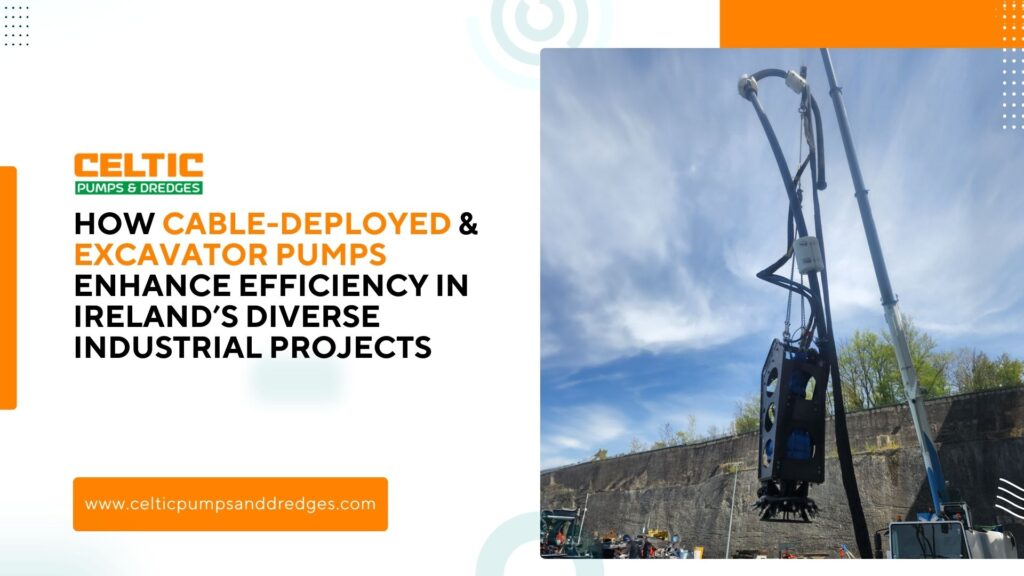
How Cable-Deployed and Excavator Pumps Enhance Efficiency in Ireland’s Diverse Industrial Projects
Industrial sites in Ireland are facing a simple operational requirement. They must transport large volumes of silt, slurry, and sludge with minimal downtime and lower overall project costs. Harbours need routine silt removal to maintain vessel access. Quarries require dependable pumping of abrasive tailings. Wastewater facilities need consistent sludge extraction to meet compliance targets. Industrial plants must clear production waste without holding up processing schedules. Most traditional industrial dredging solutions are not suited to these conditions. Large dredgers are expensive to mobilise and cannot access confined basins or narrow shoreline areas. Mechanical excavation creates double handling of material and increases transport costs. Many conventional pumps cannot handle fluctuating solids content, and frequent clogging further slows production. These limitations have prompted Irish operators to adopt more compact, adaptable systems. Excavator- and cable-deployed pumps in Ireland enable material removal from locations that are difficult to reach, where depth varies, and where the equipment footprint must remain small. These systems also eliminate the need for multiple handling stages, as material is pumped directly to the discharge point. Celtic Pumps and Dredges supplies this type of equipment to Irish industrial, marine, and municipal projects. The company focuses on pumps designed for high-solids, variable-slurry-density, and continuous-duty operation. The priority is straightforward: provide solutions that reduce downtime, increase removal rates, and fit the actual site constraints encountered across Ireland. Ground-Level Explanation: What Cable-Deployed and Excavator Pumps Do in Industrial Conditions Excavator- and cable-deployed pumps in Ireland serve the same purpose as excavator-mounted pumps. They move high-solids material from the extraction point to the discharge point without requiring mechanical loading or transport. The difference lies in how each system is positioned and controlled on-site. A cable-deployed pump is lowered into the material using a crane, davit, A-frame, or fixed lifting point. Once submerged, it agitates and pumps slurry directly through a discharge line. This setup is useful when access is limited, side entry is impossible, or depth varies beyond an excavator’s reach. Operators can adjust pump position vertically and horizontally without entering the water and without moving heavy equipment around the site. This makes cable-deployed units suitable for tanks, lagoons, deep basins, harbour pockets, and industrial pits. An Excavator and cable-deployed pumps in Ireland replace the excavator’s bucket. The excavator’s hydraulic power drives the pump. This configuration gives the operator precise control over where the pump enters the material and how it is moved through the solids. It is suitable for sites where the excavator can safely reach the removal zone, such as quarry ponds, shoreline sludge, settling basins, and industrial waste beds. Because the excavator already provides reach and mobility, the pump can be repositioned quickly without additional equipment. Both pump types are designed for high-solids environments. They handle mixtures containing sand, silt, granules, tailings, fibrous sludge, and other industrial by-products. Many models use integrated agitators or cutters to keep solids suspended long enough for pumping, preventing clogging and maintaining consistent flow. This is essential in Irish conditions, where material density and composition often change within the same project. For industrial operators, the value of these systems lies in their practicality. They reduce handling steps, minimise downtime, and provide predictable performance without bringing in large industrial dredging infrastructure. Celtic Pumps and Dredges supplies these solutions to meet the specific access limitations, solids characteristics, and discharge requirements of Irish industrial sites. The Irish Industrial Landscape and the Operational Drivers Behind Pump Selection Versatile dredging pumps for industrial projects in Ireland operate under consistent conditions that influence how industrial dredging and dewatering work is carried out. Each sector deals with material profiles and access constraints that make conventional equipment inefficient or unsuitable. Ports and small harbours operate within tight tidal windows and have limited space for large machinery. Silt accumulates quickly in berthing areas and navigation channels. Removing it with mechanical excavation requires barge loading, transport, and disposal, which increases cost and extends project timelines. Pump-based removal is preferred when consistent flow and limited disruption are priorities. Quarry and mining operations encounter abrasive tailings that quickly wear out standard pumps. Tailings ponds often have unstable edges and variable depths, which restrict the use of heavy equipment. Excavator-mounted pumps are selected here because operators already rely on excavators for daily work and can integrate the pump into existing site routines without adding specialised machines. Municipal wastewater and sludge-handling facilities need predictable solids removal to maintain treatment capacity. Lagoons, settlement cells, and balancing tanks accumulate dense sludge that cannot be moved efficiently with standard centrifugal pumps. Cable-deployed high-solids pumps are well-suited to these environments because they can be lowered into confined basins with precise vertical positioning and minimal setup. Industrial processing plants, including food, beverage, and pharmaceutical facilities, generate by-products that must be removed without shutting down equipment for extended periods. Tanks and pits in these sites often have limited side access. A cable-deployed unit provides a controlled method to clear material during scheduled maintenance intervals. Civil engineering and construction contractors require temporary pumping systems capable of handling irregular sludge, excavation water with solids, or accumulated material in cofferdams. These teams prioritise rapid mobilisation and need equipment that fits within restricted working areas. Across all these sectors, operators look for solutions that reduce the number of steps between material extraction and disposal. They want to avoid double-handling, limit machine movement, and maintain continuous operation. Excavator and cable-deployed pumps in Ireland meet these requirements because they deliver direct pumping from the removal point to the discharge location. This is why these systems are gaining traction in Ireland and why Celtic Pumps and Dredges has focused its offering on equipment built for these specific industrial conditions. How Cable-Deployed Pumps Address Common Industrial Constraints in Ireland Excavator and cable-deployed pumps in Ireland are selected when operators need controlled vertical placement, consistent pumping in deep or confined areas, and a minimal equipment footprint. These requirements frequently arise for Versatile dredging pumps on industrial projects in Ireland, where access is restricted, or material lies below the reach of standard machinery. The core advantage of